How Did the Tee Fail?
B16.9 Tee Failure
Commentary by Ron Haupt - ANSI B31 Committee member
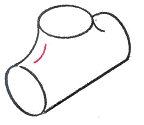
An ANSI B16.9 NPS 10 XXS Welding Tee in a piping system was designed and constructed in accordance with ASME B31.1, sized for an operating pressure of 3,500 psi, operating at ambient temperature, 21°C (70°F). The system contained water. Yet, this tee FAILED within 3 months of operation. So, how did the TEE fail?
Upon investigation, it was found that the tee had developed a crack along the red line shown in the sketch below in an orientation where the maximum pressure stress occurs, not in an orientation where the maximum in-plane or out-plane moment stress occurs.
Further, during operation it was found that the tee was subjected to a low pressure of 500 psi, but the surprise to the investigator was that the pressure cycled between 3500 psi and 500 psi two times a minute, resulting in a fatigue crack as indicated. In three months, the tee had suffered over 250,000 pressure cycles.
The owner of the piping system in which the tee was located indicated surprise that the tee failed as it was a ANSI B16.9 tee sized for the operating pressure and the owner was under the impression that B16.9 requires a proof test to prove that a fitting is as strong or stronger than matching pipe. The system piping was seamless NPS 10 XXS pipe. The owner came to realize that the B16.9 proof test is a static test and not a pressure cycling test.
This failure was not an isolated failure as a month later a similar failure occurred in a welded-on “integrally reinforced” reduced outlet branch connection in the same piping system.
The ASME B31 codes do not say much about pressure cycling as it is not expected that the typical normal operation of B31 piping will involve pressure cycling. The current extent of cautionary guidelines in B31 piping is one sentence in B31.1 which states only that special consideration should be given to restricting the use of socket welded joints where pressure cycling is expected to occur.
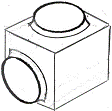
The solution implemented in this case was to add metal where the maximum pressure stress occurred in tees and reduced outlet branch connections. Thus, forged block full and reduced outlet tees replaced the existing tees and branch connections in the piping system as shown in the sketch below.
Author: Mr. Ron Haupt, P. E., of Pressure Piping Engineering (www.ppea.net) is a member of several piping code committees (B31, B31.1, B31.3, BPTCS, and others). He consults with us in the capacity of Nuclear QA Manager.
Related Articles
Comments on Butt Welds
Comments on Butt WeldsComments from Ron Haupt - ANSI B31 Committee memberQuestions below came from one of the seminar attendees; Ron Haupt replies to each.User Question:In reviewin...
Temperature Limitations in Piping Component Materials
Temperature Limitations in Piping Component MaterialsCommentary by Ron Haupt - ANSI B31 Committee memberASME B31 .3, Para. 323.2 Temperature Limitations describes low temperature r...